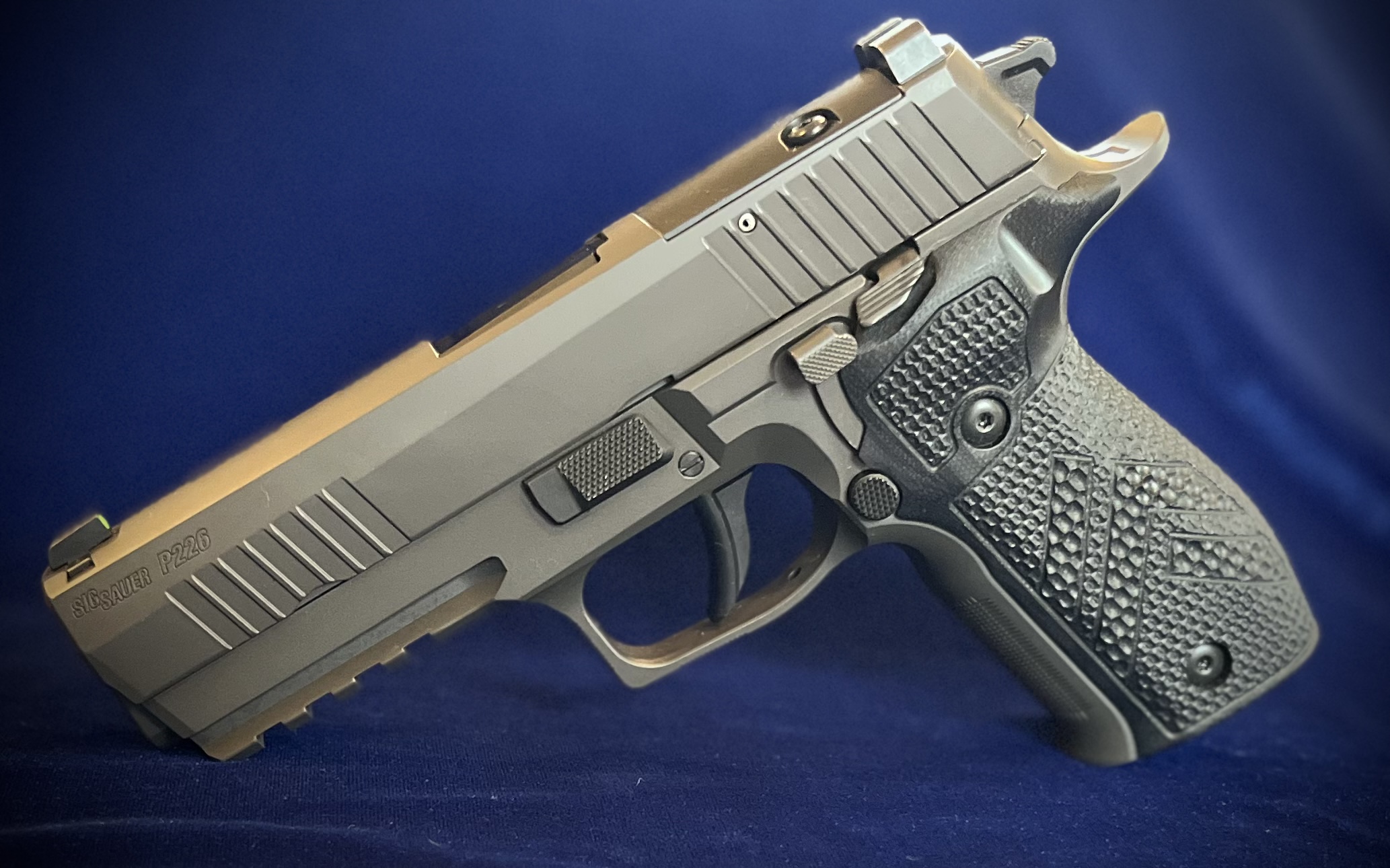
The next evolution of the premiere combat handgun
By Joe W Gorman

For the last 40 years, the legendary Sig P226 has been the tip of the spear for combat handguns. During the mid-late 80s the P226 began to displace revolvers and older automatic designs in the holsters of US lawmen and armed citizens. The P226 also became the sidearm of the US Navy Seals (as Mk25) in the late 80s. By the early 2000s, the P226 was adopted by the US Coast Guard.

Widely regarded as the perfect marriage of accuracy and reliability, the DA/SA P226 offered the capability to strike the primer of a round more than once with additional pulls of the trigger. With incredible reliability and standard 15 round magazines, it’s easy to understand why the P226 was held in such esteem.
On a personal note, way back in the late 80s, I began my first career as a park ranger and encountered my first Sig 9mm pistol in the wild. I had just stopped a car for speeding and after radioing in the license plate and location of the stop, I exited my squad car. A car pulled up and stopped in front of me. I saw an FBI special agent badge and a holstered SIG P229 on the front seat of the vehicle. The special agent showed me his ID and asked that I cite the woman driving as he had been following her for miles and she had been passing people in an unsafe manner, causing a car to leave the roadway. That Sig looked so cool and futuristic to a backwoods ranger who was used to seeing Smith and Wesson and Colt revolvers in every holster he saw. I dutifully cited her for what I had on her: 15 miles per hour over the posted speed limit.
Over the years I have owned several Sig firearms. I own two P226s, a 516 rifle and a 716 rifle. They are all remarkably accurate and are among the most reliable firearms I own. My eleven-year-old P226 SAO Legion has the highest round count of any 9mm I own and has had zero malfunctions.

New Sig P226x DA/SA Legion and author’s 10-year-old Sig P226 SAO Legion
My Sig P226 SAO Legion is the most accurate 9mm pistol that I own. As a happy Sig owner, I was excited to see the new P226 Legion X models hit the market. I requested a DA/SA model for evaluation. I noted the difference between the new vs old P226 Legions (I mean other than the fact that one is SAO and one is DA/SA). The new P226X slide is cut differently, and the rail extends further with one more picatinny slot. Looking at the firing pin safety I noted differences between the SAO and the DA/SA. Sig was never one to rest of their laurels, so the fact that the design of the internals has changed was no surprise. The grips changed to an all-dark motif (no cool legion medallion). Looking at the barrel crown of the two guns, holy cow, did Sig put a sharp angled crown on this new P226. You’d have to pack a lunch and set out to damage that crown to hurt it, such is the level of protection it now has.

Older P226 slide (left) and new P226 slide (right)
Out on the range, I needed to modify the manual of arms I’ve had drilled into my head for 43 years, and charge the pistol, then decock it using the decock lever. This concept is foreign to me. I did have a couple of Smith and Wesson 4506/4566 pistols back in the early 90s briefly, but I quickly went back to the 1911, convinced in a life-and-death moment that I would do exactly the wrong thing with a Smith auto pistol and put it on safe. The Sig decock lever at no point adds a “safe.” After decocking and pulling the trigger through a heavy double action trigger pull, the P226 DA/SA will go bang. Subsequent to the first bang, the P226 will go bang with a light SA trigger pull until the mag runs dry. This seems like it may be easier for me to learn as in a life and death situation. With a P226 in my paw, the worst I can do is wipe the slide release (no effect if the slide is in battery) and pull through the first shot. Teach an old dog new tricks and so forth. This was a long way to say, I managed to load 18 rounds of Blazer 9mm ball ammunition into a magazine and make the pistol ready to fire.

First 10 rounds through the new P226 X Legion
After emptying the first magazine by shooting the first shot DA and then following up quickly with a SA shot and depressing the decocker so I might repeat this drill, I felt I was starting to get the hang of this gun. The DA trigger pull of the P226 Legion, though noticeably longer and heavier than the SA trigger pull, was smooth, like a good revolver trigger.
I discovered I needed to grip the P226 a bit differently than a 1911 and concentrate on getting the first knuckle of my trigger finger on the center of the trigger face. This helped with the control of the first shot and helped me stay consistent on the SA shots. After 100 rounds down range, I could keep two shot strings (1 DA/1 SA) on an 8” target at 10 yards rather quickly and easily. After 200 rounds of 115gr 9mm Blazer, I changed the drill to: Draw, shoot one shot DA and two shots SA, depress decocker, holster weapon, repeat. This was confidence inspiring. The smooth trigger pull of the Sig P226 Legion and the inherent accuracy of the weapon allowed me to shoot very close to what I could shoot with one of my best 1911s and that is saying something.

The next drill I ran the P226 Legion through was reliability with self-defense ammunition and accuracy. The first part of this drill was a practical accuracy with 33% IDPA steel plates at 10 yards and I ran a full box of each type of ammo through the gun to ensure there were no problems with the different flavors of 9mm defensive ammo I had on hand: Winchester Defender 124gr, Federal 124 HST, Hornady 115gr FTX and Hornady 124gr American Gunner. There were no failures of any kind with any of the ammo.
Moving on to a stricter slow-fire accuracy test, I stood at 9 yards and shot 2 groups of 5 shots of each, with all the defensive ammo types. I used a 3” target sticker and a 6 o’clock hold and fired the first shot of each 5-shot group DA and the last 4 shots SA. I’d then press the decocker and repeat the drill. Again, I experienced zero failures and shot some very impressive groups. All the groups I shot were two inches or less measured center to center. I then repeated this drill with the Blazer 115gr fmj ammo. Even that range ammo grouped 5-shots into 2”! Sig’s new X-ray sights were easy for my old-man eyes to pick up and align. The trigger was always easy to control and the heft of the P226X made the recoil very easy to manage. After running several hundred more rounds of mil-ball ammunition through the P226X, I locked the slide back, turned the disassembly lever down, released the slide lock and the slide/barrel/recoil spring and guide came off. After a quick cleaning and a few drops of oil, the Sig P226X was ready for more.

In all types of shooting, with vastly different types of ammunition, the Sig P226X Legion DA/SA was an accurate handgun. Deliberate fire from 9 yards proved this Sig is one accurate combat weapon. Firing DA/SA from 12 yards, the author could reliably hit the bull on a B27 target.
Having established the new Sig P226X as both accurate and reliable, I knew it was time to mount a light/laser to the rail and get her ready for a home defense role. I mounted the trusty Streamlight TLR-10 and calibrated the laser to the sights. The 1,000 lumen light/laser combo works well and has withstood a lot of rounds when mounted to other semi-auto pistols. The Streamlight TLR-10 illuminates well beyond the practical effective range of any 9mm pistol.

If something should go “bump” in the night, a great weapon/light/laser package and 18 rounds of defensive ammo at the ready is a welcome companion.
Good work Sig on keeping the tip of the spear, sharp!
Links:
Leave a Reply