By Joe Gorman

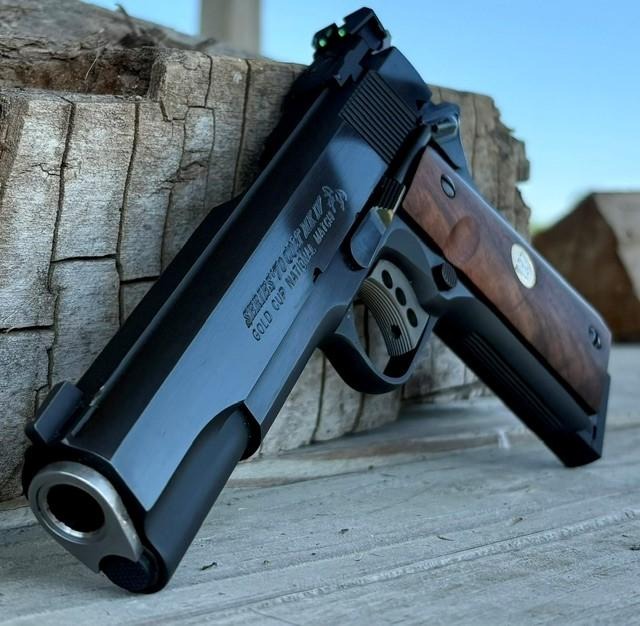
The finished product of Project Gold Cup. Check out that Colt Pony. He sure looks frisky.
Colt’s Gold Cup
The Colt Gold Cup stands as a testament to American exceptionalism. Born from the Colt National Match .45 acp 1911 in the late 1950s, the Colt Gold Cup took John Browning’s military sidearm masterpiece to stratospheric heights. The Gold Cup quickly became a standard in competitive shooting, known for its match‑grade barrel, precision trigger, angled cocking serrations and match dominating accuracy. The Gold Cup was essentially a high‑precision, hand‑fitted version of the Colt Government model, with tighter tolerances, target‑grade parts, and a specially designed trigger.

The finished product of Project Gold Cup is a crazy accurate and beautiful shooter. You could take this gun and a box of Fed Gold Medal Match ammo to a NRA 50-yard qual and earn a Distinguished Expert rating.
I recall being in high school in the early 1980s and witnessing an NRA bullseye 50 yard slow-fire pistol competition. That’s where I first got to see a Colt Gold Cup up close. As I inspected a Gold Cup on the firing line I knew I would own one someday. Fast forward to the mid-1980s and I acquired my first 70 series Gold Cup. She had a lot of miles on her, but it could still outshoot me. I successfully hunted squirrels with that pistol! (230gr hardball GI ammo does not destroy much meat)
Among other foolish things I did in the 1980s, I traded that Gold Cup for something shiny. Over the years I have come to own some very accurate 1911 .45s but I wanted a Gold Cup. Thankfully, Colt still makes them, and they roll mark them with the cool rampant pony 1970 Series roll mark.

The 1980s were a weird and duplicitous era. This is an example of a mullet, just another foolish thing a lot of us did in the 1980s. Hell, these things were everywhere in the 1980s. This hairstyle was otherwise known as “camaro hair” or “hockey hair” but by any name, it was equally absurd. We thought this was normal back then. We were not well. But my mullet was pretty long and glorious.
The new Colt Gold Cup is a beautiful pistol. They ship with double diamond Colt medallion wood grips and feature an adjustable rear sight that looks more robust than the old Eliasons. The front and rear sights are black in the finest traditions of bullseye. The steel Colt uses to craft 1911s these days is some of the finest weapons-grade steel anywhere, but it also seems to be difficult to blue. The modern blue Gold Cup looks blacker than my 1970s Gold Cup. Also, the trigger, while still wider than a GI trigger, does not look like the distinctive trigger of yester-year.

The very first group I shot when I got my Gold Cup back from Mr Smith and mounted up the L.P.A.s. I shot a group that could put 5-shots in a poker chip with my standing 15 yards away.
Out of the box, the Gold Cup trigger seemed heavy to me. It did break crisply but it measured 5.5 pounds. I had to have a better trigger for me to get the most from this pistol. The barrel fit tight to the slide. The Colt guys are masters of this aspect of 1911 manufacturing for sure. As I pondered what I had in my hands it hit me: I could upgrade a few parts on this pistol, and she’d be a match winner (with someone besides me behind the trigger). I reached out for some help with this project.

The Colt Gold Cup of yesteryear (1967 in this case)
I am fortunate to live in Iowa. Fortunate for a couple of reasons. Firstly, I am surrounded by feed-corn. Mature corn stalks are 10 ft tall, block most of the wind, increase the localized humidity to near 100% and I also believe I am significantly allergic to this plant. On days when the ambient temperature approaches 100 degrees, this means I get no cooling wind, and I expect my skin to burst into flame at any second. Secondly, and most importantly, I am just down the lane from a World-class Master Pistol Smith who has forgotten more about 1911s than I’ll ever know. After a brief discussion about what I really wanted with a Colt Gold Cup, he graciously agreed to make time to work on my project gun even though he currently has a 4 year back log. (This is why I am not identifying him). I’ll call him, Mr Smith.
Mr Smith examined the barrel to slide fit and agreed the fit was very good. He also had several stock Colt 1911 national match barrels on hand and as luck would have it, one fit in the slide even more tightly than the barrel my pistol came with! Coincidence or Providence; you be the judge.
Clark Custom Bushing
He then installed an ingenious barrel bushing made by Clark Custom Guns. According to Mr Smith, “When new, it’s too large to fit in the slide, and the hole is too small for it to slide onto the barrel. Therefore, it must be fit to your slide and your barrel. The advantage to the bushing (for me) are the 3 exterior “spines” that self-center it in the slide (once properly fit), this system makes bushing removal a breeze. Some bushings that are a gunsmith fit are a bear to remove. When the Clark bushing is turned with a wrench, 1 of the 3 spines drops into the spring plug opening, allowing removal with your fingers. It’s a brilliant concept invented by Jim Clark several decades ago.

The Clark bushing
Then I measure the exterior of the barrel, then again using the lathe (with a bit-holder I made specifically for this purpose), I open the hole so it’s the same size as the barrel diameter, + .001″ to allow for barrel expansion when the barrel gets hot.” I can say, after using the Clark bushing, I am a huge fan. It’s an awesome design.

If you look really hard at the top seriations near the front sight, you can see where I slipped with a brass punch, dented the fine steel serration on top of the slide and died a little inside. Don’t let this happen to you. Call Novak’s and have them install it for you.
Master Gunsmithing
Mr. Smith also polished the hammer and sear. He refit and polished the disconnect. He stoned the tips of the leaf spring, polished the mainspring and the inside of the mainspring housing. Mr Smith got the trigger weight to exactly 3.0 pounds! He also polished and beveled the recoil spring guide rod and fit the thumb safety so that it positively “clicks” to the safe and to the fire positions. He tuned the extractor and polished the feed ramp even more to enhance reliability with hot self-defense rounds. He polished/stoned the trigger bow rails and finally, he tightened the slide to frame fit with double-secret ninja techniques. The barrel was lapped, chamber entrance polished and the exterior was carded for smooth operation. Lastly, Mr Smith crowned the barrel as a properly crowned barrel both reduces group size and protects the muzzle.
At his place, he shot the finished Gold Cup in a Ransom Rest to test it for accuracy at 25 yards. He fired a 5-shot group of .82” with Federal Gold Medal Match 230gr ammo and a 5-shot group of .97” with Magtech 230gr ball ammo.
When I got the gun back, I could not believe how bank-vault-tight it was! I shot crazy tight groups with the freshly smithed pistol, including an ALMOST 3” group at 50 yards offhand that was ruined by a cursed flier. Sigh.

This is what it looks like to ALMOST shoot a 3” 50-yard group. That flier with the arrow next to it…that’s the story of my life. This was before I changed out the sights and grips etc.
L.P.A. Adjustable Fiber Rear Sight
My eyesight has deteriorated to the point where, only when shooting black targets on white paper (maximum contrast) can I easily find my sights, but when any colors are involved or shooting an FBI B27, I can’t find the sights well. I needed old-man-eyesight help.

The L.P.A. adjustable sight for Bomar cut was super easy to install and is very bright and solid. The adjustments feel very positive and precise. It’s tested to hold zero for at least 50K shots!
For the rear sight I turned to L.P.A. for an all-steel, adjustable rear sight that is designed for a Bomar cut. The factory rear sight was easy to remove (unlike the front sight, but more on that later) and the L.P.A. sight was easy to install. Made from high quality steel, and utilizing two steel dovetail retaining screws, the L.P.A. rear sight has been tested by the factory to retain zero for 50,000 rounds! This makes me very happy.
The installed green fiber optics light up very brightly. I can see them against any background I’m likely to encounter. I could also change them out for red fiber tubes if the notion ever strikes me.

The L.P.A rear sight and the Tritium Novak front sight allow me to align my sights on stuff besides black targets on white paper.
Once installed the adjustment (with the included adjustment tool) was very simple and a reassuring audible “click” lets you know you moved the sight.
I like Italian stuff; I like Italian cars, guns, food, music, clothes, Sophia Loren and I really like L.P.A. sights.
Novak Tritium Front Sight
The stock black front sight on the Colt Gold Cup would be fine for me still, if I was strictly shooting competition targets. You know, like the stuff the gun was designed for. But I was to shoot other cool stuff that I may encounter out in the middle of the high plains of Wyoming. I wanted a front sight that would fit in nicely with the L.P.A. rear and allow me to pick it up in low light.

Novak makes excellent tritium front sights. This model has an orange outer ring and permits precision shooting in good, bad, and low light.
I set out to drift the factory stock sight out of the slide. I dutifully wrapped the slide in painter’s tape and then carefully set it in thick deer hide before securing it into a vice. This arrangement has worked well for me over the years. After repeated whacks with a small brass punch and a light hammer did absolutely nothing other than deform the brass punch, I went for the 3/8” brass punch and an Estwing construction hammer. I really let the hammer fly. After two whacks I saw that my brass punch had left the front sight dovetail cut and dented the delicate top strap serrations. It was at this point I surrendered.
I arranged for Novak’s sights to install one of their tritium-center-dot-with-orange-outline front sights. This worked great. The orange dot was easy for me to find in bright light and allowed for some precise shooting, even on multi-colored targets.
The new Novak front sight even features a 1/16” taper pin that helps really secure the sight in place.

The L.P.A. rear and the Novak front sights. Very tough and visible.
Let this serve as a cautionary tale. I’ve not talked to anyone who enjoys removing the front sights on Colt 1911s. Plus side, boy are they ever mounted to stay put! But removing them is difficult. Thanks to Novak’s, I got my front sight mounted.
If you are ever visited by the Good Idea Fairy and the notion strikes you to change out the factory sights on your new Colt 1911, please put a large rubber band tightly on your wrist. Whenever that idea presents itself, repeatedly snap the rubber band, striking your wrist as hard as possible, until that notion goes away. Then box up your slide and send it to Novak’s.
Wilson Combat Parts
Wilson Combat has earned a reputation as a tier-1 supplier of 1911 parts in a crowed aftermarket marketplace. The quality of their magazines, springs, 1911 internals have always impressed me. I have solved more than one 1911 failure-to-feed problem by using a Wilson magazine and observing that the problem disappeared.

Wilson Combat provided essential parts for this project. You can trust Wilson gear.
I intended to shoot some hot +P ammunition through the Gold Cup and wanted to protect the frame etc from the battering it may encounter by using a stock 16-pound recoil spring. I installed a Wilson Combat 20-pound recoil spring and Shok-Buff buffer. This set up would allow the pistol to function with 230gr hardball at 850fps and 200gr HAP bullets coming out at 1100fps without added wear and tear on the pistol. Some of the hot SD ammo I shot during testing was 230gr in the 1000fps neighborhood.

Wilson 500 series magazines for +P ammo never let me down. Their ammunition is accurate and packs a punch.
I used two Wilson Combat 500HD mags designed for +P loads in black. These attractive magazines proved their worth during testing. I experienced no failures with factory ammunition, and these mags played a large part in that. I have some very old Wilson 1911 magazines that I still run after years and years of service. They are always a good choice.

When going in harm’s way, doublecheck what mag you have inserted…
I also mounted some very attractive Wilson dark walnut smooth grips on the Gold Cup. The grips feature large, champagne-colored Wilson medallions that present a nice visual contrast to the black of the pistol. They are ambi-cut in case that matters (it didn’t to me in this case) and they are relieved on the left panel to allow magazine release without shifting dominant hand grip.
Ready on the right. Ready on the left. Ready on the firing line.
Shooting the Gold Cup in finished form was very fun. The pistol functioned like a dream and as I mentioned earlier, I ALMOST shot a 3” group at 50 yards. I have shot a 4” group at 50 yards, exactly, once. But still…

Don’t hate me because I’m beautiful. Oh and extremely accurate.
For testing how well she shot, I mostly relied on 200gr Hornady HAP bullets over 8.4gr of WAP powder and magnum primers. (Yes, back in the 90s I bought WAP by the 8-pound keg and I still have some left) These loads worked well. I experienced two failures with these loads, but the brass also had a million miles on it. This load is very accurate out of the Gold Cup.

Author’s Galco Combat Master and Galco Casual Belt 1911 rig. This rig has almost 20 years and a million miles on it.
I shot Hornady Critical Duty 220gr +P loads that were also very accurate. This load measured over 1000fps from the muzzle of the Gold Cup! Yeeeehaw! The Hornady Critical Duty round is designed to stay together when encountering a barrier like a car windshield. I could hold these rounds to under 2” offhand at 15 yards. I experienced no malfunctions in 40 rounds.


Hornady’s Critical Duty ammo never missed a beat and is really moving! I got a 1021 average speed for a 220gr flex-lock hollow point that laughs at windshields. And probably car doors too.
Wilson Combat 45 acp ammunition has always done well in our tests and evaluations. It performed well in the Gold Cup too. The Wilson Combat .45acp loads we chose were crafted from Hornady 230gr XTP bullets loaded to +P velocities. This load claims 925fps on the box but we saw an average velocity of 937fps from the Gold Cup. This load was extremely accurate too with 5 shots typically coming in under 2” at 15 yards with me pressing the trigger. I experienced no malfunctions in 40 rounds, testing with the Wilson Combat load.


Wilson makes a lot of great parts for combat firearms. They also make great ammo!
Winchester Service Grade, brown box .45 acp ammunition was also tested. This stuff even tested well in the Gold Cup. Accuracy was generally right over 2” at 15 yards. We measured 828fps on average and we experienced no malfunctions.

There’s a place for 230gr plain old hardball loads. Project Gold Cup ate these rounds up just fine and they were pretty accurate too.
Parting Thoughts

Author ready to unleash hell 230-grains at a time. Youngest graduated from USCGA this spring so I’m her hypeman for the next 5 years.
Project Gold Cup was a great success. It’s an incredibly accurate pistol that I genuinely look forward to shooting. The trigger break and the excellent sights mean I can actually stand up and shoot this gun, offhand, and do really well, most of the time. Except for those fliers that seem to haunt me.

Like Goldilocks’ porridge, this Gold Cup is just right.
There is magic in an incredibly accurate Colt Gold Cup. There always will be.
For more information:
Leave a Reply