by Joe Gorman
Concept
The rifle I am building for this article is, what I consider to be, an “everyday rifle.” This is the rifle you can put in a padded soft case and throw it in the truck when you head out. This is the rifle you can carry into a national forest and not be thought of as “that guy” they way you might if you were carrying an AR. This rifle can take down the largest game in North America, defend you and yours in any environment, be shot just for fun at targets and steel and most of all, won’t draw attention like black rifles do.

The Marlin 1894 .44 Magnum as she shipped from the factory
I want this rifle to be accurate enough to engage targets out to intermediate ranges and flat shooting enough to hit a coyote at full broadside out to 200 yards with just a touch of good old Kentucky windage. In my case, this rifle will also need to be able to humanely harvest Iowa white tail deer out to at least 150 yards.
I have always preferred field rifles to have iron sights for use in case something were to take the scope out of action. Accordingly, this rifle needs quality irons, a rail to accommodate an extended eye relief scope, low-rise scope rings with a decent zero-return when removed and a LPVO. Speaking of the optic, I also want a simple reticle and superior light gathering ability in a lightweight package.
The caliber selection is a critical choice as well. I want the overall weight of this rifle to be low and the overall length to be short. But I also don’t want this rifle to batter the heck out of me. Painful recoil isn’t fun to me. No 460 Weatherby rifles need apply. Further, I want this rifle to be capable of carrying 10 rounds of ammunition and have a quick rate of fire. These requirements lead me to select the .44 Magnum as the caliber and Ruger’s new Marlin 1894 lever action rifle to be the base rifle.

The Marlin 1894 modified to be the Everyday Rifle. With the XS Lever Rail, iron sights, Leupold VX-Freedom Scout Scope and Leupold Back Country rings, this rifle can fill multiple roles.
While most of us would not go looking for Brown Bear with a .44 Magnum, there are documented cases of hunters killing mature Brown Bears and Grizzlies with .44 Magnum revolvers. The extra 400 fps a 20” rifle barrel can provide to certain .44 Magnum loads, over the same round being fired from a 4” revolver, can nearly double the energy imparted on the target. In other words, it’s a completely different level of power when using slow burning powder and fired from a rifle. It’s also much easier to place a bullet where it needs to go with a rifle versus a revolver. This rifle will be light and handy enough as to not be a burden to a hiker. I want to be able to remove the scope if I want light weight and I’m not hunting in twilight.
The Build
The shooting world breathed a collective sigh of relief when Ruger bought Marlin and hit it out of the park with the 1895 SBL release last year. I should be no surprise to anyone that Ruger would also build a great 1894 rifle. From the factory, Marlin’s new 1894 is a beautiful example of the modern lever gun. The walnut selected for the stock and forearm is truly first class, and fit and finish look better than ever. Finally, I get to see a Marlin with old school bluing again. The lettering on the barrel is crisp and well executed. The six-groove rifling in the 20” cold-hammer forged barrel is precisely cut and led to some great accuracy. The overall length of the rifle is 37.75’ and it weighs a mere 6.4 pounds.
I opted for an XS Lever Rail Ghost Ring with front sight for the new 1894. The high quality XS sight/rail came with a fully adjustable aperture sight, a beefy, white-striped front sight and plenty of rail space to mount almost anything. The rail is both durable and attractive high-grade aluminum and it’s made in Texas! XS has also smoothed the corners a bit to not draw blood if you grab the rail in a hurry. It withstood hundreds of factory and reloaded .44 Magnum rounds without loss of zero. The XS Lever Rail allowed me the flexibility to zero the XS iron sights (I used the larger of the two supplied apertures) and leave the sights in place while installing low Leupold Back Country rings and a Leupold VX-Freedom 1.5-4X28 Scout Scope. The Back Country low rings provide enough clearance for the bells on the Leupold, even when using Butler Creek covers, and get you almost the same cheek weld as when using irons. I zeroed my sights for 100 yards with same load I’ll use when hunting with the scope: 240gr XTP over 23.5grs of 296.

The XS Lever Rail and the Leupold Back Country rings. A solid foundation for optics is important.
The Leupold VX-Freedom IER Scout Scope measures only 11 inches overall and tips the scales at a svelte 9.6 ounces and it is the perfect optic for this build. Turned down to the 1.5x setting the Leupold provides over 41ft of field of view. With this forward mounted optic, keeping both eyes open to position the crosshairs over a target means you have 180 degrees of vision. The classic Leupold Duplex reticle draws your eye to the center of the crosshairs automatically and the clarity of the Leupold glass lets you see clearly, even after legal sunset. Inevitably I see the most deer in twilight (in Iowa shooting hours end half an hour after legal sunset) and if there is no snow on the ground, you are searching for a brown deer in brown crop fields. Amazingly, the Leupold VX line of scopes allows me to see into the twilight better than more expensive glass I have laying around the office! I took four scopes out into a picked bean field after sunset and the humble Leupold VX scopes let me distinguish targets the best of the bunch. I had scopes with me that cost three times the price of the little VXs, and yet the VX scopes transmitted the most detail in low light. It is worth noting that throughout my testing, my groups were tighter with a traditional scope ( I used Leupold’s excellent Mark3 HD 1.5-4x for this test) but to get the scope low and close to the bore, I’d have to remove the rear sight. Given the requirements of this rifle—able to hit a basketball at 200 yards—I acknowledge and accept this limitation.

The Leupold VX-Freedom 1.5-4×28 Scout. This scope allowed me to keep the rear aperture sight on and run glass!
Testing
Having assembled all the parts of my Cowboy Scout Everyday Rifle, I began the range test phase. I ran through 200 rounds of full power 240 and 200 grain Magnum ammunition from Winchester and Hornady without incident. The rifle showed definite signs of ammunition preference. It particularly liked 240 gr jacket offerings from Hornady Custom, XTP ammunition and Winchester, White Box ammunition. Hornady’s Custom 200 grain XTP ammunition also grouped well from the 1894.

This group was fired at a bench using irons on a particularly windy Iowa day.
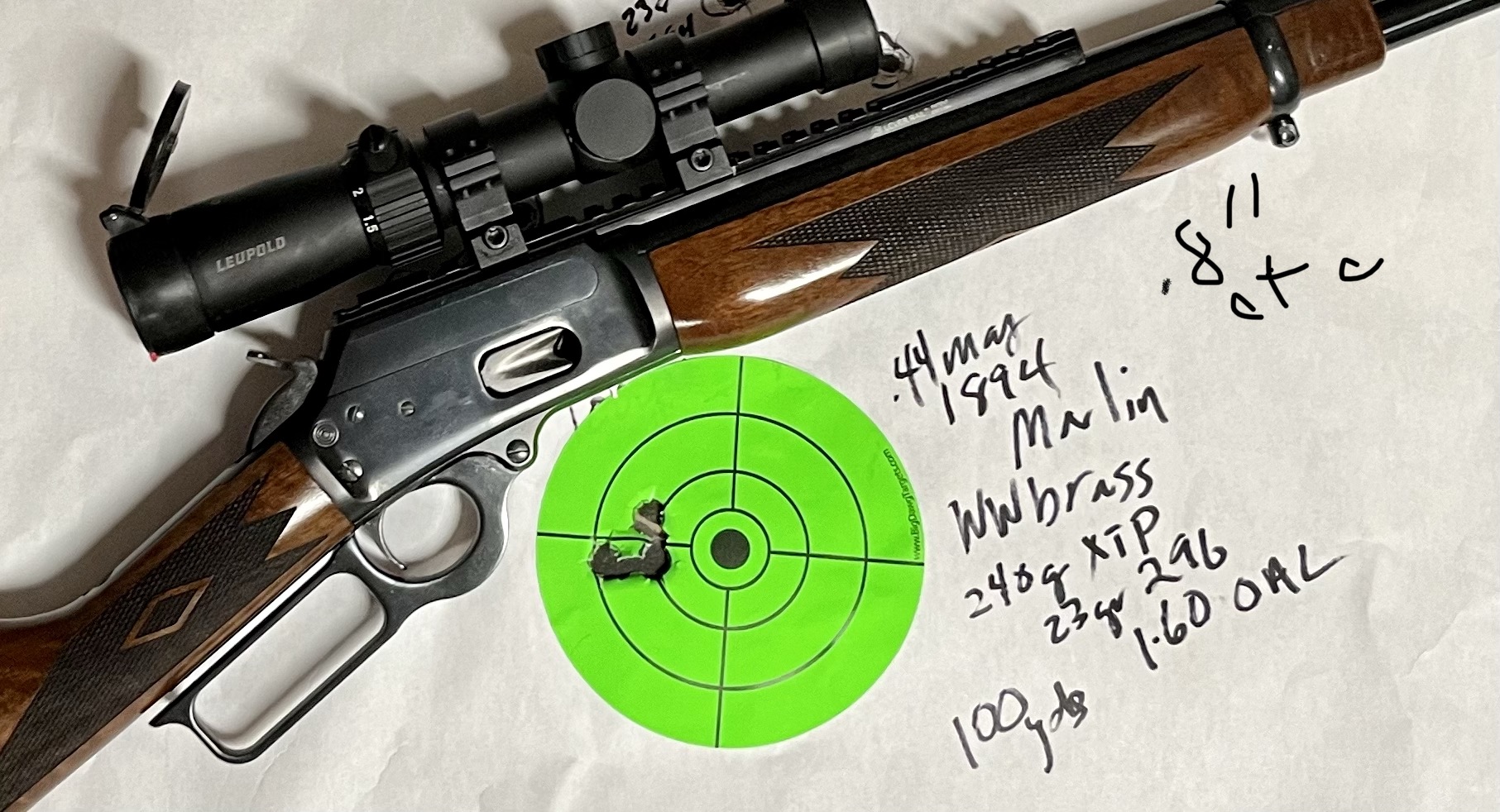
As I worked up reloads, I found that the 1894 preferred Hornady’s 240 grain XTP bullet, especially when pushed to 1750fps at the muzzle with a stout charge of 296 and a Magnum CCI primer! This load grouped consistently at about 2.5 inches at 100 yards (with a couple 3-shot groups coming in at 1 inch!). The trajectory of this load was such that, when zeroed to be 1.5 inches high at 100 yards, it is dead on at 125 yards, a foot low at 200 yards and it stays supersonic out past 200 yards! At 200 yards this round retains 750 ft lbs of energy!

This group was fired at a bench using irons too on a much less windy day. This was an exceptionally good group for me, even with the flyer.
The Hornady 240 grain XTP bullet is a great choice for hunting white tail deer in my experience. It’s not the crushing penetrator that a hard cast 300 gr gas checked bullet would be when loaded to magnum pressures but it will get the job done on 180 pound deer. The humble Winchester white box 240gr jacketed soft point ammunition provided groups just slightly larger than when shooting the 240 gr XTP reloads but I have experienced these rounds passing through deer without tremendous expansion. This might make a good choice when hunting deer in bear country as they will tend to break heavy bone.

Mounting a traditional scope (Leupold Mark 3 HD 1.5-4×20) requires removing the rear sight, but I was rewarded with generally tighter groups. Pick what is important to you.
For practical accuracy, standing shots at steel IDPA A-zone targets are easily made at 50 yards. I would prefer a lighter trigger pull but the factory trigger is serviceable. Rapid fire strings with full power magnums are quick and by keeping the muzzle on target I get a sight picture by the time I’ve chambered a fresh round. It’s not too difficult to hit IDPA A-zone steel plates 10 of 10 times in under 10 seconds from 50 yards. It’s also possible to hold a bad guy at gun point and reload an 1894 at the same time. This is not a modern military pattern rifle, but it’s no slouch in nearly any tactical situation most of us might reasonably find ourselves in.
As testing continued, I had the opportunity to test my setup in the rain. I removed the scope and used the XS iron sights. I put 5 shots in a 2.75” group at 100 yards. It would have been a sub 2” group but for a flyer. After remounting the Scout Scope, I was able to shoot a 3” group that was centered on target. My deer hunts are typically conducted in late December. In Iowa, late December can bring brutal winds and snow. It can also bring moderate temps and clear skies. The former is more common for when I hunt so practicing shooting in the rain needed to be part of this testing.

This group was fired in the rain for no good reason. Who else gets a brand new rifle soaked from heavy rain just to say they did it? The guys at Guns and Stuff Reviews, that’s who.
Conclusion
The Leupold VX-Freedom Scout Scope, secured by Leupold Back Country rings on the XS sight rail performed superbly. There is no danger of scope bite with this rig. Removing and then remounting the scope to the same rail slots got me back to Minute of Deer zero. The high visibility XS front sight allowed me to shoot at least as accurately as with the scope in place in bright light with contrasting targets. As previously mentioned, I see a lot of deer in very low light and without snow, I need glass for my old eyes. In bright sunlight, I like using the irons. Throw the T27/T15 tool that comes with the Leupold Back Country rings in your kit bag so that you can remove the scope if you want use this rifle sans optics.
The Marlin 1894 is an accurate and dependable rifle capable of harvesting large game and light weight and handy enough to be your constant companion on wilderness hikes. When rigged out with the rail, the sights, the rings, the scope and 10 rounds of 240gr .44 Magnum, the overall weight is a svelte 7.8 pounds.

This was the best 3 shot group I fired from this rifle. Yep, shot from a bench with a traditional scope.
Manufacturer Contact Info:
https://www.marlinfirearms.com/
https://www.cci-ammunition.com/
Leave a Reply