By Joe W Gorman

Think we’d let little things like freezing temperatures and snow and wind interrupt our testing of Joe’s latest build? No way. Sun’s out, guns out.
For this project, I wanted to build up a 5.56 mm AR capable of MOA groups (or under) out to 700 yards using heavy match ammunition. Such a rifle would be very handy on my semi-annual pilgrimages to South Dakota, to rid the prairie of varmints, from 700 yards away. I have been using a Ruger Precision Rifle (RPR) in 6.5 Creedmoor as my long-distance rifle for the past three years and have scored a confirmed hit on a prairie dog at 825 yards with it. The RPR can maintain sub-MOA groups out beyond 1,000 yards, though it is a heavy beast, and I refer to it as a 26” barreled, varmint-howitzer.
The advantage of a smaller rifle, shooting less expensive (though not by a whole lot) ammunition and still allowing a reasonable chance at hitting a varmint in the open at 700 yards is attractive to me. A standard-size AR will also fit in my SKB AR Rifle hardcase and could allow my pack out to be one rifle case.
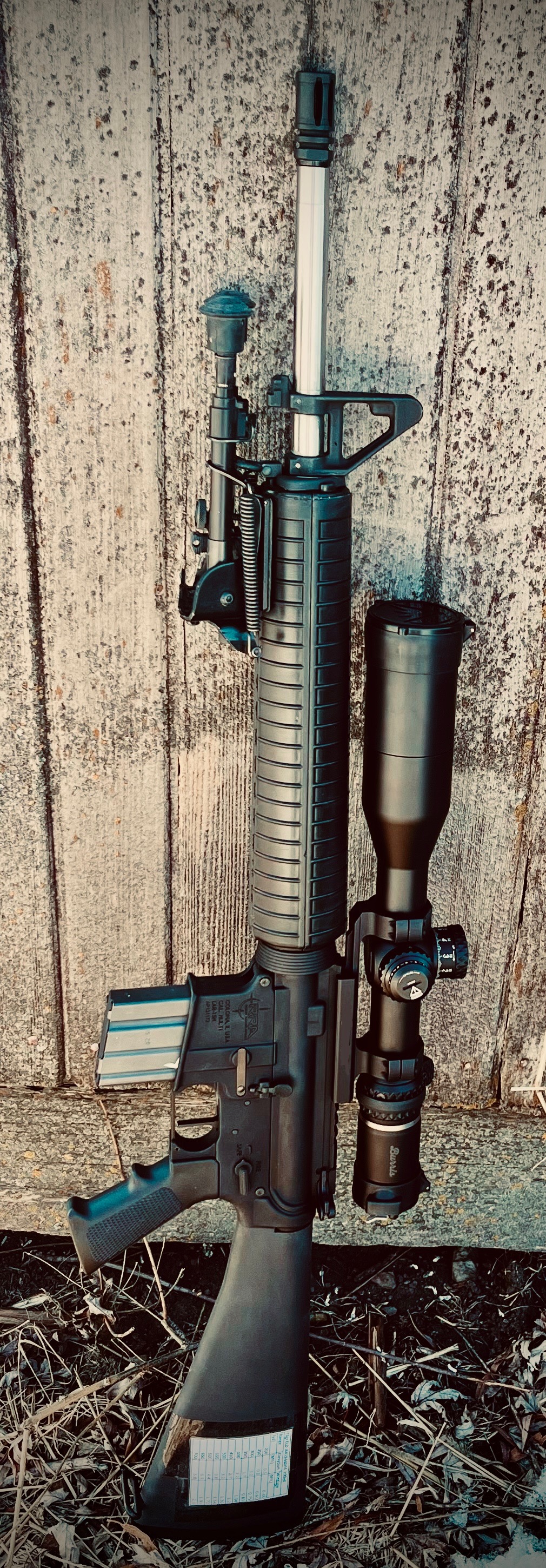
I chose the Rock River Arms (RRA) AR15A4NM upper, mounted to a RRA A2 lower as the project rifle. This rifle has proven to be accurate with a variety of ammunition and with its heavy, Wylde-chambered, 1/8 twist match-barrel, it maintains accuracy through multiple-shot strings. I have used this rifle to shoot numerous ¾ MOA groups out to 200 yards.
I grew up in the carry handle Mafia and remember well when the A2s came out. Good days (old man memories kick in.) The lines of the A2 will always be classic in my mind and I like big, round handguards and I cannot lie. By discretely free-floating the barrel with the A4NM, RRA has created an ideal sleeper precision rifle platform.
The Trigger
For precision rifle work, I have found the right trigger is the key to consistency. My 6.5 RPR is fitted with a two-stage Timney trigger that has an 8-ounce first stage and a 1 pound second stage. The installation of the Timney trigger made a huge difference in medium and long-range group consistency. When I learned that Timney made a “Pro” drop-in trigger for the AR platform I ordered one. The Timney AR Pro is a two-stage competition target trigger with an 8-ounce first stage and a 1.5-pound second stage.

Meet the Timney Pro AR Trigger. If you’ve read my previous articles, you may have noticed that I am rather partial to Timney products. There is a reason; they work! I’ve never had trouble installing a Timney and in all the weapons I’ve added Timney triggers to over the years, I’ve never had one fail.
Installation was straight ahead and simple. In ten minutes the RRA rifle was ready to go with a new trigger and the measured trigger weight was just what Timney claimed.
The Optics
Burris glass, with the SCR 2 MIL reticle, has allowed me to make some great varmint shots over the years. I scored a confirmed-prairie-dog-kill at 360 yards with 40gr .22 long rifle CCI MiniMag ammunition, shot with a Ruger Custom Shop 10/22 sporting a Burris RT-15 FFP scope. USN CWO4 Don Zeien was spotting for me when I made the shot (actually, as I recall, I took about 10 shots) that scored the kill. He will testify, under oath, and pain of imprisonment, that this shot was made as described, much to the amazement of myself, Chief Warrant Zeien and most likely, the prairie dog. After we both realized I made the hit, I commented “Don, what would you say if someone you didn’t know came up to you at a party and said they head-shot a prairie dog at 360 yards with a .22 rimfire?” He replied, “I’d just smile and nod. After they had left, I’d say ‘what a bullshitter! He just told me he shot a prairie dog at 360 yards with a .22 rimfire!’”

Burris’s fantastic SCR 2 MIL reticle. For fast long range shooting it’s hard to top.
The Burris RT-15 allowed me to hold roughly 14 MIL over the target using the Christmas tree. As there was some Kentucky windage, and a bucket full of luck involved in this shot, that worked well. For the current project, I knew I’d be much more reliant on rolling up the elevation and windage knobs than using the Christmas tree. I also needed a heavy-duty scope that could stand up to serious field work, harsh environmental conditions and probably, an occasional bump on the ground. For the distances I wanted to shoot at, and in the conditions I knew I’d be in, I selected the Burris XTRIII 3.3-18x50mm illuminated with the SCR 2 MIL reticle.
The Burris XTRIII 3.3-18×50 features a rugged 34 mm body, a positive zero-stop elevation knob, side parallax adjustment, index-matched hi-lume lens coating and top-quality glass. One other aspect of the XTR line worth noting is the repeatability of the elevation and windage knob adjustments; adjust all you want, when set back to zero, you will be back at zero.

The sturdy and dependable Burris XTRIII. The XTR line of scopes just keep getting better.
Mounted in a cantilever AR mount, I was able to get the eye piece in the sweet spot for my cheek weld and I was rewarded with a generous eye box even on maximum magnification. The XTRIII’s clarity allowed me to line up precise shots on paper targets out to 300 yards (the furthest my back yard range allows). The clarity of the Burris glass permitted reading marks I made on targets with a sharpie, from 300 yards. They were big, bold marks to be sure but with the eyepiece and parallax dialed up correctly, the image was amazingly clear. I also installed the sunshade (included with the scope) for the duration of my testing. I don’t see a downside to keeping the sunshade in place and it does offer additional protection for the objective lens.
The Bipod
Harris Bipods has been in business since at least 1979. They have always been, in my book, the yardstick by which the rest are judged. When the swivel bipods came out, I thought all my prayers had been answered. Harris created a bipod I could use on a hillside and not have to adjust when on uneven ground. Harris continues to make awesome bipods for bench and field work.

The Harris S-BRM is a fantastic bipod. It’s the gold standard!
All precision rifles in my safe wear Harris bipods in both bench and field configurations. I installed a medium length bench rest swivel bipod (S-BRM) on the RRA and used it throughout testing for this article.
The Ammunition
I evaluated several types of ammunition during my testing for this article. I tested match ammunition, FMJ ammo (not with penetrator tips) and varmint ammunition. I could get MOA accuracy out of Fiocchi 50gr VMAX .223, Federal American Eagle 50gr JHP .223, Hornady Black 62gr FMJ 5.56mm and Hornady 73gr ELD Match .223. Interestingly, my Colt AR15A4 and the RRA both liked the 62 FMJ 5.56 Hornady Black. I could reliably ring 3” steel plates at 300 yards with the Black ammunition.

Hornady’s .223 73gr ELD Match Ammunition routinely shot ½ MOA groups at 300 yards.
I settled on Hornady’s 73gr ELD Match ammunition after this ammo repeatedly turned in the tightest groups. This round’s high ballistic coefficient allows it to remain supersonic past 950 yards. The goal of this project is a long-range precision rifle, and this ammo seemed to be the perfect match (absolutely no pun intended).

I ended up shooting quite a bit of ammo for this testing. I was so impressed with the performance of the Hornady 5.56mm 62gr FMJ Black ammo that I tested it in my Colt AR15A4 with a 10x scope on 3” steel targets at 300 yards. Nailed 3/4. The miss was due to the human shooting. That rifle with the 62gr FMJ Black ammo was solid MOA!
Groups of the 73gr ELD, shot at 100 yards, were typically between .4-.75” measured center to center. Amazingly, as I moved the targets out to 300 yards, the RRA precision rifle and Hornady 73gr ELD team shot groups consistently right at, or just under 1.5”! That’s 1/2 MOA at 300 yards. I have no doubt the rifle and ammunition will hold sub-MOA to 700 yards but I will have to wait until summer to prove it in South Dakota.


Sort of hard to argue with a 5.56mm AR that routinely shoots ½ MOA groups at 300 yards. Even during moderately windy conditions, the high BC of the ELD ammunition allowed good groups to be scored.

The best group shot to date is under 1/3 MOA! Incredible.
Conclusion
As this is a work in progress, this section should really be titled “Conclusion Thus Far.” I am flat out amazed that modestly priced, 20” 5.56mm rifle can maintain poker-chip-sized groups all day long at 300 yards. My goal of having a AR-sized, 5.56mmNATO chambered tack driver, utilizing high quality glass, a stable bipod and high ballistics coefficient ammunition that can nail varmints at 700 yards, appears to be met. I concede the proof is in the proverbial pudding, but I have no doubt that that this rig will acquit itself well in the field. My precision 5.56mm AR ended up at 13.3 pounds with everything in place. That weight helped to keep the rifle steady during testing. The Government A2 has an ideal weight/balance to my mind for a fighting rifle. This rifle is more like the M16’s chunky cousin. In keeping with the design goal however, it is ½ MOA accurate, shoots a round that is less expensive than the 6.5 Creedmoor 147gr ELD round that feeds the RPR and it is smaller and lighter to boot. More later!

At 100 yards the RRA AR15A4NM delivers groups that a bolt gunner would love.This group, fired from 200 yards with Hornady 73gr ELD Match ammunition certainly inspired confidence.
Leave a Reply